
Where to Find the Best Long Term Value in the Greater Seattle Area Right Now

The Answer Is Not Metro Wide
Every week a buyer asks me some version of this question: with prices doing different things in different places, where do I actually look if I want this to be a sound long term decision?
It is one of the most honest and intelligent questions a buyer can ask. And the answer, in this market, requires something that a metro wide average simply cannot give you: neighborhood specific knowledge.
The greater Seattle area is not one market behaving one way. It is a collection of distinct communities, each with its own supply and demand story, its own buyer pool, its own employment base, and its own equity history. Some areas that surged wildly during the pandemic years have come back down. Some have held with remarkable steadiness. And some are quietly becoming the most compelling value plays in the entire region for buyers who know where to look.
I grew up in the Pacific Northwest, riding my horse through thousands of acres of National Forest after school and all summer. I have lived in this region for over 40 years. When I tell buyers where long term value lives in this market, I am not reading from a regional report. I am describing communities I know at the level of the street, the school zone, the commute corridor, and the neighborhood association.
Cheryl Dillon is a Realtor in the greater Seattle area helping buyers and sellers navigate King and Snohomish County markets with clarity, strategy, and a genuinely personalized approach.
Why Metro Wide Averages Are Misleading Right Now
If you have been following Seattle area real estate headlines in 2026, you have seen a version of this story: prices are softening. Or: prices are rebounding. Or: the market is cooling. Or: competition is back.
All of these things are true simultaneously, in different neighborhoods, at different price points, in different property types. That is the reality of a metro area as geographically and economically diverse as greater Seattle, and it is why a single headline number is almost always the wrong foundation for a purchasing decision.
Here is what is actually happening at a structural level:
The downtown Seattle condominium segment is experiencing a notable rebound in 2026. Return to office mandates from major employers have pushed demand back toward urban living. Buyers and renters who want to be within walking or transit distance of their office are re engaging with the urban core in a way that was largely absent from 2020 through 2023. This is a real and measurable shift in condo pricing and absorption in the city center, and it is specific to that property type and that geography.
Meanwhile, single family home prices across the broader metro have plateaued or seen subtle softening in many communities, particularly in areas that experienced the most dramatic appreciation during the 2020 through 2022 period. These were communities where prices moved well ahead of their fundamental value drivers, including school quality, employment access, lifestyle amenities, and supply constraints, and the market has quietly corrected toward equilibrium.
The communities that have held with the most resilience are the ones with real, durable fundamentals: top tier school districts, strong community identity, proximity to major employment corridors, and a lifestyle proposition that attracts buyers for reasons beyond price momentum. And in the North Corridor of the greater Seattle area, those communities are showing up clearly.
What "Long Term Value" Actually Means in Real Estate
Before we talk about specific communities, I want to define the term clearly, because it gets used loosely in ways that can mislead buyers.
Long term value in real estate is not about the neighborhood that appreciates fastest in a hot market. Fast appreciation in a hot market can signal speculation as much as it signals fundamental strength, and speculative appreciation tends to correct when conditions change.
Long term value is about the community that holds its value through cycles. It is the community that attracts consistent, qualified demand from buyers who chose it deliberately, that has supply constraints that protect against oversaturation, and that offers the kind of daily life that people return to generation after generation.
The markers I look for in a community with genuine long term equity strength are consistent:
Strong, well regarded public schools. School district quality is one of the most powerful and durable drivers of residential real estate value in the country. Buyers with families prioritize it, and the demand that creates is not speculative. It is structural.
Employment access. Communities with strong connections to major employment corridors, including tech, aerospace, healthcare, and government, attract a steady, income qualified buyer pool regardless of broader economic conditions. Transit adjacency amplifies this effect significantly.
Community identity and investment. Neighborhoods with active community organizations, well maintained public spaces, and a sense of local pride hold their value better than those without it, because buyers are choosing a lifestyle as much as a structure.
Supply constraints. Communities where land is limited, where development is regulated, and where the housing stock is not easily expanded are naturally protected against the oversupply that can erode value over time.
The North Corridor communities of the greater Seattle area, including Edmonds, Bothell, Lynnwood, Mountlake Terrace, Mukilteo, and Mill Creek, check these boxes in ways that the market data is beginning to reflect clearly.
The North Corridor: Where Fundamentals Are Strongest
Buyers asking me for neighborhood specific guidance on long term value in 2026 are being pointed consistently toward the North Corridor communities along and west of the I 5 and I 405 corridors in North King and South Snohomish County. Here is why, community by community.
Edmonds: Lifestyle Value With Supply Protection
Edmonds is one of the most structurally protected communities in the entire greater Seattle area for long term real estate value.
The geography of Edmonds creates natural supply constraints. The city sits on a bluff above Puget Sound, is bounded by the water to the west, and has limited undeveloped land. New supply is limited by both geography and a community wide commitment to preserving the character that makes Edmonds what it is. When supply cannot easily expand to meet demand, values hold through cycles in ways that more expandable communities simply cannot match.
The lifestyle proposition here is exceptional and durable: walkable waterfront, ferry service to Whidbey Island, a genuine arts community, restaurants and boutiques along Fifth Avenue, the Edmonds Center for the Arts, and the kind of small city completeness that buyers from every life stage are drawn to. The Edmonds School District has maintained strong academic outcomes across its campuses, making it consistently attractive to family buyers. And the proximity to the Sound Transit light rail connection at Mountlake Terrace and the planned service improvements along the Edmonds corridor add a transit adjacency premium that is only increasing over time.
Buyers who are comparing Edmonds to communities that appreciated sharply during the pandemic years will find that Edmonds has been more measured in its appreciation and more stable in its holding. That is not a weakness. That is a feature.
Bothell: The North Corridor's Strongest All Around Value
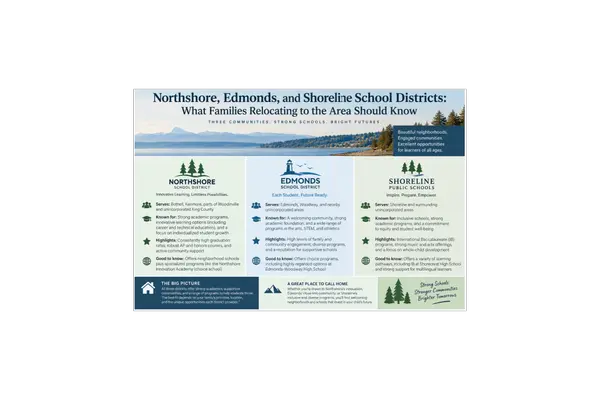
Bothell sits at the intersection of nearly every long term value driver in this market: the Northshore School District, which is consistently ranked among the top public school systems in Washington State; strong connectivity to both the Eastside tech corridor via I 405 and the SR 522 corridor to the north; a revitalized downtown with genuine community investment and weekend energy; and a housing stock that ranges from established craftsman era homes with mature tree canopies and large lots to newer construction that attracts relocating families.
The Northshore School District is not a peripheral amenity in Bothell. It is a primary driver of demand. Families who are choosing their community specifically for its school quality, and there are many of them relocating from across the country, consistently identify Northshore as a top tier destination. That demand is structural, not cyclical. When the economy shifts, when tech hiring slows, when interest rates fluctuate, families who moved to a community for its schools do not pick up and leave. They stay. And that stability is reflected in Bothell's price resilience over every cycle I have worked through in this region.
For buyers who want a community with genuine upside from both the lifestyle investment and the long term equity picture, Bothell is one of the most compelling answers in the greater Seattle area right now.
Lynnwood: The Transit Adjacency Play
Lynnwood deserves a dedicated conversation, because its long term value story in 2026 is being driven by something specific and measurable: the Lynnwood Link light rail extension.
Sound Transit's light rail connection to Lynnwood City Center Station is now operational, and the impact on this community is real. Transit adjacent real estate has historically outperformed surrounding markets over the long term, because light rail access fundamentally changes the employment access equation. A buyer in Lynnwood who can commute to the University District, South Lake Union, or downtown Seattle without a car is a buyer who can tolerate a longer distance from the urban core, and who is paying Lynnwood prices for Seattle employment access.
The value gap between Lynnwood and the South Lake Union and Capitol Hill communities it now connects to via light rail remains significant. Buyers who understand what transit adjacency does to long term value, and who are purchasing in Lynnwood for that reason, are making a fundamentally different kind of investment than buyers who are simply choosing based on today's price per square foot.
Beyond the transit story, Lynnwood has the Edmonds School District, improving retail and dining options around the City Center development, and a price point that continues to offer meaningful value relative to communities to the south and east. The combination is attracting serious buyers who are doing their homework.
Mukilteo: Undervalued Relative to Its Fundamentals
Mukilteo is the community I reference most often when buyers ask where genuine value still exists in this market. The gap between what Mukilteo offers and what it charges for it is wider than almost anywhere else in the North Corridor.
Puget Sound waterfront. Lighthouse Park, one of the best public parks in Snohomish County. The Mukilteo ferry dock connecting to Whidbey Island. A Boeing adjacent employment base that gives this community economic resilience independent of the tech sector. The Mukilteo School District, which has consistently produced strong academic and extracurricular outcomes. And home prices that are meaningfully below comparable Edmonds properties to the south despite a lifestyle that buyers who make the comparison find nearly equivalent.
The buyers who discover Mukilteo seriously, who actually visit, walk the streets, sit at the waterfront, and compare the numbers, almost always find it compelling. The buyers who overlook it are usually doing so because they have not done that comparison yet. When they do, the value gap is difficult to ignore.
Mill Creek: Family Value With New Construction Appeal
Mill Creek attracts a specific and loyal buyer pool: families who want newer construction, a master planned community with strong common spaces and HOA maintained amenities, excellent schools through the Mukilteo and Everett school districts, and a community that takes genuine pride in where it lives.
The newer construction in Mill Creek tends to offer the open floor plans, modern kitchens, and primary suite layouts that today's buyers prioritize, at price points that are more accessible than comparable new construction on the Eastside. The community's proximity to the I 5 and I 405 corridors gives it strong employment access across multiple economic sectors.
For buyers who are choosing between Mill Creek and comparable communities closer to the urban core, the comparison almost always favors Mill Creek on a value per dollar basis. The trade off is commute time to downtown Seattle and some of the inner Eastside employment centers, and buyers who come in with realistic expectations about drive times consistently find the value proposition compelling.
The Downtown Condo Picture: What Buyers Should Know
The urban core condo market deserves a separate note, because it is moving differently from the suburban single family picture in ways that matter for buyers considering that property type.
Return to office mandates from major Seattle employers are driving renewed interest in downtown Seattle and South Lake Union condominiums. Buyers who want walkability to their office, access to the urban energy of the city center, and the lifestyle that accompanies dense urban living are re engaging with the condo market after several years of relative quiet.
This is a real trend, and it has produced measurable improvement in condo pricing and absorption in the urban core. For buyers who are drawn to that lifestyle and who have the financial position to sustain urban ownership, the current moment is interesting. Prices are still below their peak, inventory has improved, and the demand trend is moving in a direction that supports long term value for well located units.
The caution I offer condo buyers in any market is consistent: location within the urban core matters enormously. Walkability score, proximity to light rail and bus rapid transit, quality of the building and its HOA financial health, and the specific micro neighborhood all shape long term value in ways that a single price per square foot comparison cannot capture. These are conversations worth having carefully before committing to a specific unit.
A Story From the Field
I recently worked with a couple who came to me having done significant research on their own. They had identified four communities they were seriously considering and had spent weeks reading market reports and tracking prices online. What they could not figure out was which of the communities they were considering had the fundamentals for long term stability, and which ones had simply looked attractive because of pandemic era price momentum they did not fully understand.
We spent several conversations breaking down exactly what had driven prices in each community over the prior five years, where that growth was rooted in durable fundamentals versus temporary conditions, and what the equity trajectory looked like based on the structural drivers, including school districts, employment access, supply constraints, and community investment, rather than the recent price history alone.
They chose a community in the North Corridor. They are in their home now, in a neighborhood with strong school district access, transit adjacent upside, and a community they love. And they made that decision from a place of clarity rather than momentum.
That is what neighborhood specific guidance is supposed to do. Not just tell you what prices are doing today, and instead help you understand why, and what that means for where you want to plant roots.
Frequently Asked Questions
Where should I buy a home in greater Seattle for the best long term value?
The communities with the strongest long term value fundamentals in 2026 are in the North Corridor: Edmonds, Bothell, Lynnwood, Mukilteo, and Mill Creek. These communities combine top tier school districts, strong employment access, transit adjacency, supply constraints, and community identity in ways that support durable equity over cycles. Neighborhood specific guidance from a local agent is the most reliable way to identify the right fit for your specific goals.
Are Seattle condos a good investment in 2026?
The urban core condo market is experiencing renewed demand driven by return to office mandates, and prices have improved from recent lows. Well located condos near light rail and major employers are showing positive momentum. The key variables are location within the city, building quality and HOA financial health, and your personal lifestyle alignment with urban living. These decisions benefit from careful, specific guidance rather than category level generalizations.
Which Seattle suburbs have the most stable home values?
Communities with strong school districts, transit access, supply constraints, and durable lifestyle amenities have historically been the most stable. In the greater Seattle area, Edmonds, Bothell, Mukilteo, Lynnwood, Kirkland, and Redmond consistently demonstrate this kind of resilience. Snohomish County communities in the North Corridor in particular offer a compelling combination of value and stability for 2026 buyers.
Does buying in a good school district really affect home values?
School district quality is one of the most powerful and consistent drivers of residential real estate value in the country. Strong school districts create structural demand from family buyers who are choosing a community specifically for its educational options. That demand is durable across market cycles in a way that speculative demand is not. In the greater Seattle area, the Northshore School District in Bothell, the Edmonds School District, and the Mukilteo School District are among the most powerful value anchors in their respective communities.
What does transit adjacent mean for Seattle home values?
Transit adjacency, meaning proximity to light rail, bus rapid transit, or major transit hubs, adds a measurable premium to residential real estate values by expanding the effective employment access of a community without requiring a car. The Lynnwood Link light rail extension is the most significant current example in the greater Seattle area, connecting Lynnwood buyers to South Lake Union, Capitol Hill, the University District, and downtown Seattle. Historically, transit adjacent properties have outperformed comparable non transit adjacent properties over the long term.
Is Edmonds WA a good place to buy real estate?
Edmonds has some of the strongest long term value fundamentals in the greater Seattle area. Its waterfront geography creates natural supply constraints, its school district is well regarded, its lifestyle amenities are durable and distinctive, and its community identity attracts buyers who choose it deliberately rather than by default. For buyers prioritizing long term equity stability, Edmonds consistently earns a serious look.
Are prices still softening in greater Seattle or are they stabilizing?
It depends entirely on the community and property type. The downtown condo market is seeing renewed strength. Single family home prices in the broader metro have plateaued or seen modest softening in areas that overheated during the pandemic. Communities with strong fundamentals, including school districts, transit access, and supply constraints, have shown significantly more price resilience than communities where pandemic appreciation was primarily momentum driven. The most accurate answer for your specific situation requires current, neighborhood level data.
Ready to Find Where Your Long Term Value Lives?
The best real estate decisions are not made from market reports. They are made from a clear understanding of what you need, a trusted local guide who knows the specific neighborhoods you are considering, and the willingness to look at fundamentals rather than headlines.
If you are ready to have a real conversation about where long term value lives in the greater Seattle area and which community is the right fit for your life, I am here for that conversation.
Cheryl Dillon is a Realtor in the greater Seattle area helping buyers and sellers navigate life transitions with clarity, strategy, and a genuinely personalized approach.
📞 425 954 5622 📧 Cheryl@CherylDillonRealEstate.com 🌐 CherylDillonRealEstate.com 📍 1455 Leary Way #400, Seattle, WA 98107
Cheryl Dillon is a licensed REALTOR® in the state of Washington with EXP Realty.
Categories
Recent Posts







GET MORE INFORMATION