
Why Tech Professionals Are Choosing 425 Over 206 in 2026

A Shift That Is Happening Right Now
Every week I speak with buyers who are making a move that surprises even them. They came to the Pacific Northwest for a role at Amazon, Meta, a biotech firm in Bothell, or one of the dozens of technology companies anchored along the I-405 corridor. They started in South Lake Union or Capitol Hill or a Bellevue high rise. And somewhere along the way, something shifted.
They realized that what they actually wanted from their life here was not the density, the parking stress, the noise, or the premium price tag of the urban core. They wanted the Pacific Northwest they had imagined when they accepted the offer. Trees. Space. Trails out the back door. A neighborhood where their children could grow up rooted in a real community. A morning where the commute does not cost them an hour of their life, and their home is not the size of a hotel room.
That is the story behind a very real migration happening right now across the greater Seattle area. Tech professionals, biotech researchers, and medical device engineers are choosing the 425 over the 206, and the reasons are as practical as they are personal.
I grew up in the Pacific Northwest, riding my horse through thousands of acres of National Forest after school and all summer. I have lived in the Seattle area for over 40 years, and I have watched this region grow from a place most of the country had barely heard of into one of the most influential technology ecosystems on earth. When I tell buyers what it is actually like to live here, in Bothell, in Edmonds, in Mukilteo, in the communities along the North Corridor, I am not reading from a fact sheet. I am describing a life I have lived and a market I work in every single day.
Cheryl Dillon is a Realtor in the greater Seattle area helping buyers and sellers navigate life transitions with clarity, strategy, and a genuinely personalized approach.
The Commute Math That Is Changing Everything
The assumption that Seattle-adjacent tech workers need to live in the urban core or the inner Eastside to have a sustainable commute is being revised in real time by buyers who actually run the numbers.
Here is what the commute picture looks like for tech professionals working at the major campuses in the greater Seattle area when they consider the 425 communities of Bothell and Edmonds.
For Amazon employees working at the Bellevue campus, which has become Amazon's primary HQ2 location, Bothell sits along the I-405 corridor in a position that connects directly and efficiently. The SR-522 and I-405 junction, which runs through the heart of Bothell, is not simply an interchange; it is the primary arterial that links the North Corridor to the Eastside employment base. Bothell to Amazon Bellevue on I-405 south runs approximately 20 to 30 minutes in typical conditions, which is a commute many inner Eastside residents can only claim on their best days.
For Meta employees working at the Bellevue campus, the same corridor applies. Kirkland, where Meta also maintains a presence, is similarly accessible from Bothell via the I-405 corridor in times that compare favorably to commutes from many Seattle neighborhoods, without the bridge crossing volatility that affects westside-to-Eastside commuters.
For tech professionals whose employers are in Redmond or on the Microsoft campus, Bothell provides access via SR-522 east to SR-202 that experienced local commuters know well, and the North Creek corridor connects Bothell to Redmond in times that often beat what buyers expect before they actually drive the route.
For professionals who work from home two or three days per week, and that hybrid reality describes a large portion of the tech workforce in 2026, the commute equation shifts even further toward the 425. A 30-minute drive on in-office days is meaningful freedom when weighed against the price, the density, and the lifestyle trade-offs of living closer to the urban core.
The Biotech Advantage: A Job Engine Right Here in the 425
One of the most compelling and least discussed aspects of the Bothell real estate story is the Bothell Technology Corridor, and specifically the Canyon Park Business Center and the North Creek corridor that together form one of the most concentrated biomedical and life science employment clusters in the entire Pacific Northwest.
Bothell is home to more than 60 life science and biotech companies, making it one of the most significant biomedical hubs in Washington State. The companies operating in and around the Canyon Park Business Center include major names in medical devices, oncology, cell therapy, diagnostics, and pharmaceutical manufacturing.
What this means for professionals working in these industries is something genuinely rare: the ability to effectively eliminate the highway commute entirely. A biotech researcher or medical device engineer living in Bothell, Edmonds, or Lynnwood and working in the Canyon Park corridor may have a commute measured in minutes rather than the kind of drive that defines the experience of most Seattle-area tech workers. That is a quality-of-life advantage that does not show up in salary negotiations, and it is one of the most meaningful reasons tech and life science professionals who discover the North Corridor community tend to stay.
The University of Washington Bothell, which shares a campus with Cascadia College in Bothell, feeds the regional talent pipeline and strengthens the educational and intellectual ecosystem of the community, adding another dimension to Bothell's appeal for professionals who value being in an environment where growth, innovation, and learning are embedded in daily life.
What the 425 Offers That the 206 Simply Cannot
The lifestyle case for the 425 communities is not just about the commute. It is about the totality of what daily life looks like here, compared to what the same salary buys in the urban core.
- Space, both inside and outside. A technology professional earning a strong income in the Seattle area who chooses to live in Bothell can access a four-bedroom home in an established neighborhood with a real yard and mature trees for a price that buys a two-bedroom condominium in Capitol Hill or Belltown.
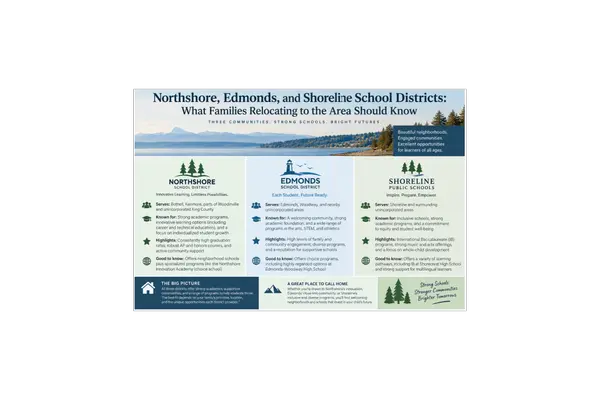
- The Northshore School District. For tech families with school-age children, or those planning to have them, the Northshore School District is one of the most powerful draws in the entire region. Consistently ranked among the top public school systems in Washington State, Northshore produces outcomes that tech families accustomed to competitive educational environments find genuinely impressive.
- The Pacific Northwest lifestyle that brought you here. The Sammamish River Trail, which runs through Bothell and connects to a broader trail network, offers the kind of outdoor daily access that most urban residents drive to.
- Room to breathe without losing connection. The North Corridor communities of Bothell, Edmonds, Lynnwood, Mukilteo, and Kenmore offer the combination of genuine neighborhood identity, practical daily life infrastructure, and access to major employment corridors that feels genuinely difficult to find in a market as large and expensive as greater Seattle.
The Price Difference Is Real and It Compounds
The financial case for the 425 communities deserves direct attention, because in 2026 the price gap between the 206 zip codes and the North Corridor communities represents a real and meaningful difference in what buyers can own and what they can build.
In mid-2026, Bothell home prices have experienced a year-over-year adjustment, providing opportunities for buyers who were previously priced out. While the median sale price remains around $999,000, market conditions have shifted, with more inventory available compared to last year, giving buyers a bigger selection to choose from.
For a tech professional on a strong income who is also considering the long-term equity picture, this price differential has compounding implications. A home purchased in Bothell at a competitive price point allows a buyer to carry a more comfortable mortgage, invest the difference, and build equity in a community with the school districts, employment access, and lifestyle fundamentals that support durable long-term value.
Frequently Asked Questions
Why are tech professionals leaving Seattle for the 425 area?
The combination of lower home prices compared to the urban core, more space, stronger public schools in districts like Northshore, manageable commutes to Eastside tech campuses, and the Pacific Northwest lifestyle those communities deliver is driving a real and measurable migration.
How long is the commute from Bothell to Amazon Bellevue or Meta?
From Bothell via I-405 south, the commute to Amazon's Bellevue campus or Meta's Bellevue presence typically runs 20 to 30 minutes in standard conditions.
What is the Bothell biotech corridor and who works there?
The Canyon Park Business Center and North Creek corridor in Bothell form one of the most concentrated biomedical and life science employment clusters in the Pacific Northwest, hosting more than 60 life science and biotech companies.
Is Edmonds WA close enough to commute to major tech campuses?
Yes. Edmonds residents have access to the I-5 corridor for Seattle employers, the Lynnwood Link light rail station for transit access, and the SR-524 and I-405 connection for Eastside campuses.
What does the Northshore School District offer tech families?
The Northshore School District is consistently ranked among the top public school systems in Washington State, offering advanced STEM programming and strong academic outcomes that tech families prioritize.
Ready to Explore the 425?
Whether you are a tech professional who has been watching the 425 communities from a distance, a biotech or medical device professional who wants to understand what living close to your work in Canyon Park could actually look like, or a family who is ready to trade urban density for the Pacific Northwest lifestyle that brought you here in the first place, I am here for a real conversation.
Cheryl Dillon is a Realtor in the greater Seattle area helping buyers and sellers navigate life transitions with clarity, strategy, and a genuinely personalized approach.
Phone: 425-954-5622
Email: Cheryl@CherylDillonRealEstate.com
Website: CherylDillonRealEstate.com
Cheryl Dillon is a licensed REALTOR® in the state of Washington with EXP Realty.
Categories
Recent Posts









GET MORE INFORMATION